



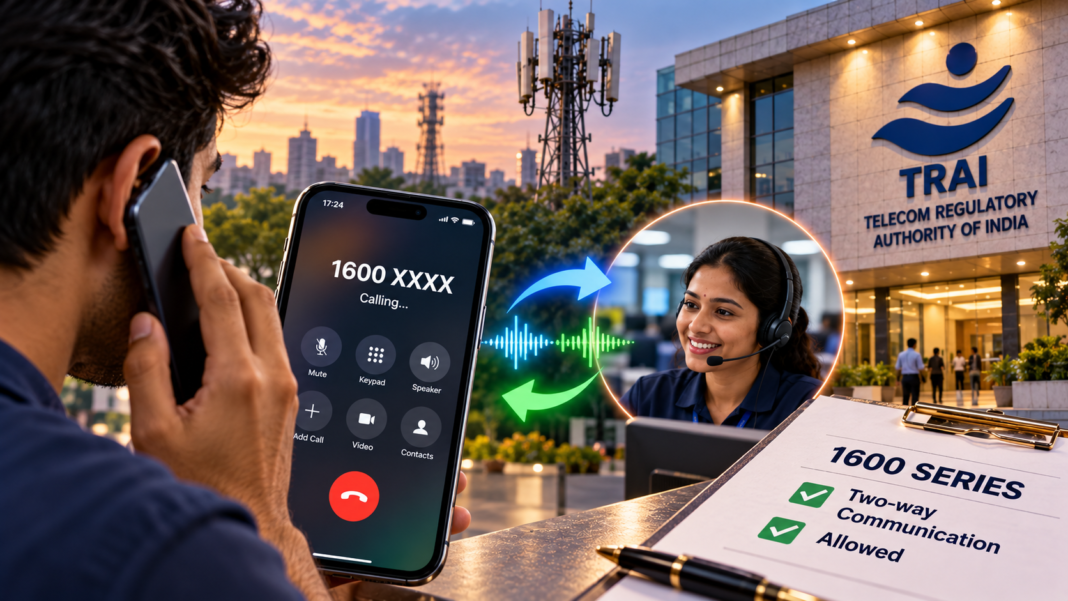
Understanding TRAI 1600 series numbers is now essential for every bank customer in India, as a major update announced in October 2026 finally allows two-way communication for financial services. The Telecom Regulatory Authority of India (TRAI) has officially permitted banks and regulated financial entities to enable callback features on these specific telephone lines.
Previously, customers were left frustrated when they missed an important bank call and could not ring the institution back on the same line. This critical policy change ensures that consumers can now return calls safely to seek clarification on their accounts.
The decision directly addresses a massive flaw in the older telecom framework. By allowing two-way communication, the regulator hopes to rebuild trust in legitimate financial calls while pushing back against the rising tide of impersonation fraud.
Key Takeaways
- Two-way calling is here: You can now call back on the designated numbers if your bank or financial institution has enabled the feature.
- Clearer identification: The framework is specifically designed to make genuine service and transaction-related alerts instantly recognizable.
- Spam app restrictions: Third-party caller-identification applications are strictly barred from labeling these designated numbers as spam.
- Alternative outreach: If you block the designated number or do not answer, banks still have the regulatory green light to reach you via alternate phone numbers.
- Fraud reduction: The centralized numbering system significantly reduces the risk of scammers successfully pretending to be your bank manager.
- Ongoing awareness: The Indian Banks’ Association (IBA) and individual banks are actively running educational campaigns about this shift.
- Security remains key: A recognizable caller ID is never an excuse to hand over your OTP, PIN, or passwords.
What Are TRAI 1600 Series Numbers for Banks?
The 1600 numbering framework was initially introduced to give regulated financial institutions a unique, recognizable identity. According to the telecom regulator, these digits are strictly reserved for service and transaction-related communications.
This helps everyday consumers instantly separate urgent banking alerts from annoying promotional calls. Promotional communications are legally restricted to the 140-series prefix, making the distinction clear.
However, the original rollout of the system had a glaring operational problem. It functioned primarily as an outgoing-only channel for the banks.
A customer might receive a crucial call regarding a suspicious transaction, a pending loan, or a payment failure. If they missed the ring, they had absolutely no way to dial the same number back to resolve the issue.
TRAI has now officially solved this bottleneck. As reported by the regulator, these designated numbers can comfortably support two-way communication moving forward.
Why TRAI 1600 Series Numbers Prevent Spam Confusion
For years, bank customers have been bombarded with calls regarding account activities, KYC updates, and loan approvals. Scammers easily exploited this routine by calling from ordinary 10-digit mobile numbers.
Fraudsters would confidently pretend to represent major banks, tricking innocent people into transferring funds or sharing sensitive credentials. The introduction of a dedicated numbering sequence creates a verified safe channel.
When you see a call starting with 1600, it is a strong indicator of a legitimate service call. It is assigned only to eligible financial entities operating under strict regulatory guidelines.
TRAI’s broader mission requires all regulated financial organizations to adopt these designated contact numbers. They are working on sector-specific timelines to ensure a smooth, nationwide transition.
The ultimate goal is not just to hand out new phone numbers. It is to establish an unbreakable chain of trust where consumers can confidently recognize their bank calling.
Caller-ID Apps Face New Restrictions
Millions of Indians rely on caller-identification applications to filter out unknown numbers and avoid daily spam. However, crowd-sourced spam reporting often backfires when frustrated users incorrectly flag legitimate banking lines.
To fix this, TRAI has officially barred third-party caller-ID apps from tagging TRAI 1600 series numbers as spam. This prevents urgent banking communications from being automatically sent to the digital trash bin.
The regulator argues that unauthorized digital filtering services should never undermine a national telecom framework. Authorized entities must be able to use their assigned lines without unfair algorithmic penalties.
While this reduces one major layer of confusion, it does not mean every incoming call is flawless. Fraudsters continuously invent new ways to spoof identities or mimic official channels.
Therefore, customers must treat the caller ID as a helpful indicator, not absolute proof. Always verify the actual substance of the caller’s request.
How Two-Way Calls on TRAI 1600 Series Numbers Work
Allowing customers to call their banks back sounds simple, but it represents a massive shift in telecom infrastructure. Below is a breakdown of how the updated system operates.
| Feature | How the Framework Operates |
| Number Series | 1600 |
| Primary Purpose | Service, alerts, and transaction-related communications |
| Incoming Calls | Two-way communication is now permitted by regulators |
| Customer Callback | Allowed instantly, provided the bank has enabled the facility |
| Spam Labels | Third-party caller-ID apps are strictly barred from marking them as spam |
| Alternate Contact | Banks may use standard numbers if the primary call fails to connect |
This updated framework is incredibly important because it drastically increases utility for both the consumer and the enterprise. Instead of a one-way megaphone, the number becomes a reliable customer service hub.
The Problem With One-Way Communication
Before this update, a missed call from a legitimate institution created massive anxiety for the consumer. You might recognize the number as your bank, but calling it back led to a dead end.
This limitation was especially dangerous during time-sensitive emergencies. If a customer missed a fraud alert regarding their credit card, assuming it was spam was a costly mistake.
Banks also suffered heavily from this one-way street. A secure communication network is entirely useless if customers are too afraid to answer or unable to respond.
Permitting callbacks elegantly solves a large portion of this friction. It hands power back to the consumer, giving them a direct route to follow up on complex financial matters.
However, the telecom regulator admits this change does not clear every hurdle. Device-level call blocking by users remains a challenge that banks must navigate.
What Banks and the IBA Are Doing Next
The Indian Banks’ Association (IBA) and participating banks have launched aggressive awareness campaigns. They are using social media and email newsletters to educate the public about the new numbering system.
Public awareness is the absolute most important piece of this puzzle. A dedicated phone line only works if the person receiving the call understands who is on the other end.
Financial institutions are working around the clock to ensure their backend systems can handle the influx of callbacks. This requires significant upgrades to existing customer service software.
The delicate balancing act for the IBA is to build familiarity without encouraging blind trust. Customers must learn to recognize the number while still refusing to share OTPs over the phone.
Background and Context
The push for a cleaner telecom environment has been a multi-year effort in India. Regulators have consistently battled telemarketers, scammers, and unregistered financial advisors.
Historically, banks used a chaotic mix of shortcodes, landlines, and regular mobile numbers to reach their clients. This lack of standardization made it incredibly easy for criminals to blend in.
By strictly separating promotional marketing (140-series) from critical account services (1600-series), TRAI laid the groundwork for this current update. The callback feature is simply the logical next step in securing digital India.
What We Still Don’t Know
Despite the positive announcement, a few critical operational details remain unclear. We do not yet know the exact deadline by which every single bank in India must enable the two-way feature.
Furthermore, it is unknown how smaller cooperative banks and regional rural banks will afford the infrastructure upgrades required for mass callback handling. According to the regulator, sector-specific timelines are in place, but public dates are missing.
Lastly, we do not know how third-party caller ID applications will technically comply with the spam-ban mandate, or what penalties they face for failing to do so.
What It Means for Indian Readers
For the average Indian bank customer, this is a massive victory for convenience and security. The most immediate benefit is the end of frantic Google searches trying to find a customer care number after missing an urgent call.
If you miss a ping about a failed UPI payment or a loan EMI, you can simply tap the number in your call log and connect back. It consolidates banking communication into a single, trusted thread.
Over time, as familiarity grows, the stress of answering unknown numbers will decrease. However, it also means readers must stay vigilant if their bank calls from a non-1600 number when the primary line is blocked.
What to Watch Next
Industry experts will be closely monitoring how quickly major private and public sector banks roll out the callback facility. The transition phase will likely be messy as banks update their IVR (Interactive Voice Response) systems.
We will also watch to see if scammers attempt to spoof the TRAI 1600 series numbers using advanced VoIP technologies. Regulators will need to stay one step ahead of identity masking.
Finally, keep an eye on how Truecaller and similar apps adjust their interfaces to comply with the strict new anti-spam marking rules.
Frequently Asked Questions
1. What is the designated 1600-series number in India?
It is a specific numbering sequence assigned to eligible banks and regulated financial entities. It is used strictly for service updates and transaction alerts to help customers avoid spam.
2. Can I now call back my bank on these lines?
Yes. The telecom regulator has officially permitted two-way communication, meaning you can return missed calls if your specific bank has activated the feature.
3. Why did TRAI ban caller-ID apps from marking them as spam?
This restriction ensures that urgent, legitimate communications from banks are not incorrectly hidden or labeled as junk by third-party applications.
4. Does seeing this verified number mean the caller is 100% safe?
No system is completely foolproof. You must never share your OTP, ATM PIN, or banking passwords, even if the caller ID looks legitimate.
5. Will my bank ever call me from a normal mobile number again?
Yes. According to official sources, banks are still permitted to use alternate numbers if they fail to reach you on the primary line, especially if your phone blocks unknown calls.
6. What is the difference between 140 and 1600 numbers?
The 140 prefix is legally reserved for promotional marketing and sales calls, whereas the 1600 prefix is reserved strictly for active service and account-related alerts.
7. What should I do if a caller from a designated number asks for money?
Hang up immediately. Legitimate banks will never ask you to transfer funds or share sensitive credentials over a phone call. Contact your bank via their official app instead.
Disclaimer: The information provided in this article is based on the latest regulatory announcements regarding telecommunications and banking frameworks. Unverified claims regarding specific bank rollout timelines remain unconfirmed. Always verify unexpected financial requests independently through your bank’s official application or website. We do not endorse sharing sensitive data over the phone.
For more updates on secure banking, check out our guide on Business and Companies and learn how to protect yourself in our latest report on AI. You can also review the official guidelines on the TRAI Website.