


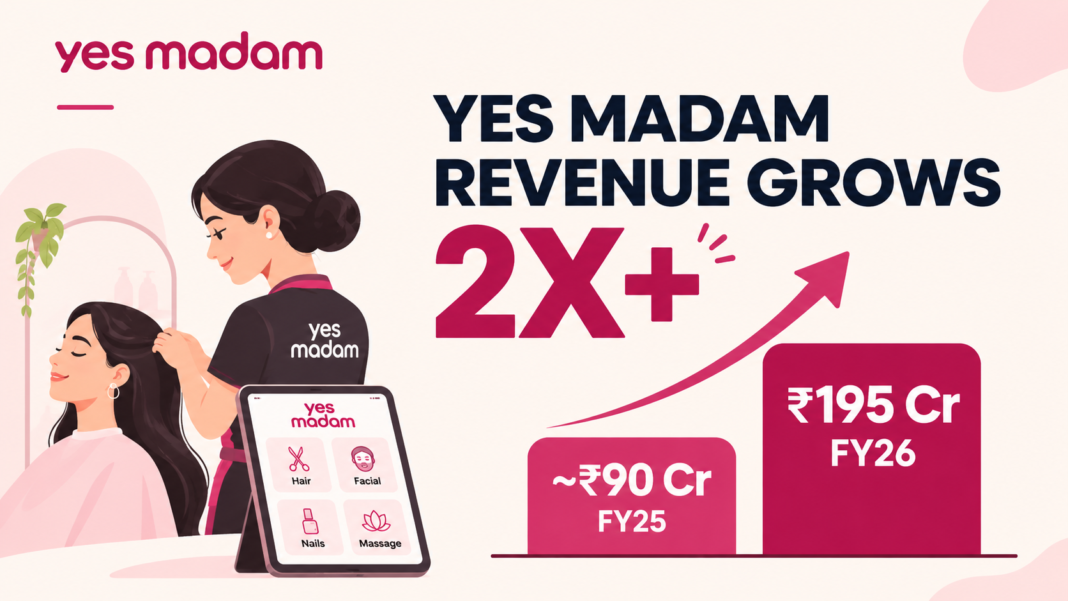
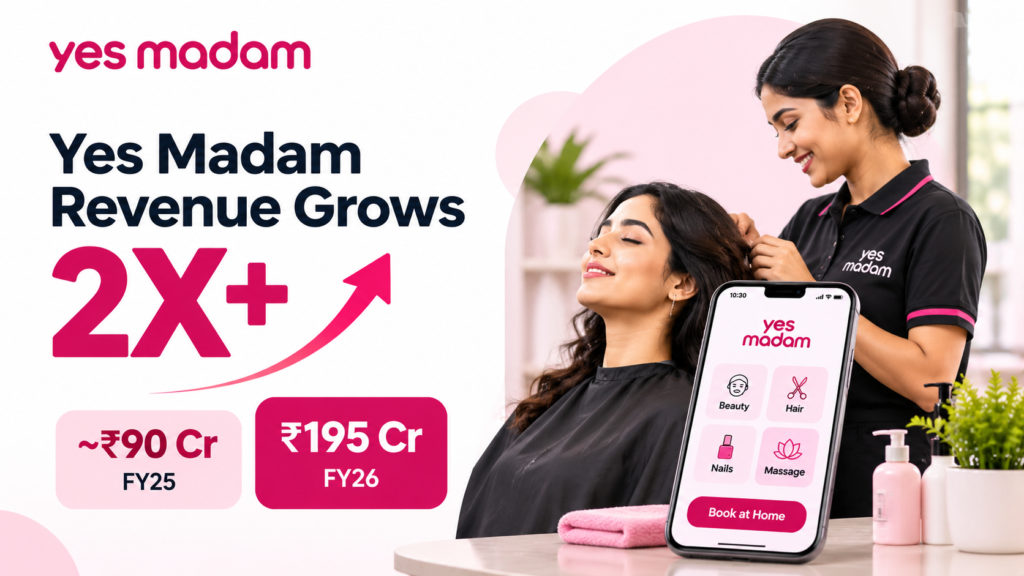
Yes Madam revenue more than doubled in FY26, reaching ₹195 crore against ₹94 crore a year earlier, according to the Noida-based home beauty and wellness platform’s financial statements filed with the Registrar of Companies (RoC). It is the second year in a row that revenue has more than doubled. But expenses grew faster, and the company went from a ₹1.83 crore profit in FY25 to a ₹7.75 crore net loss in FY26.

The result shows how hard it is to turn fast growth into earnings in at-home services. This article covers the numbers first, then adds our own analysis of where the money went and what to watch next.

Yes Madam Revenue and Loss: 7 Key Facts
Revenue: ₹195 crore in FY26, up 107% from ₹94 crore.
Net result: A loss of ₹7.75 crore, against a profit of ₹1.83 crore in FY25.
Total expenditure: ₹203 crore, up about 121%.
EBITDA margin: Fell to -3.89% from 2.18%.
Biggest cost: Advertising and promotions, at ₹67 crore.
Cost per rupee earned: ₹1.04, up from ₹0.98.
Funding: ₹50 crore from Info Edge earlier in 2026, plus reported talks for ₹250 crore more.
Yes Madam FY26 Financial Performance
| Financial Metric | FY25 | FY26 | Change |
|---|---|---|---|
| Operating revenue | ₹94 crore | ₹195 crore | +107.4% |
| Total expenditure | ₹92 crore | ₹203 crore | +120.7% |
| Net profit or loss | ₹1.83 crore profit | ₹7.75 crore loss | Shift to loss |
| EBITDA margin | 2.18% | -3.89% | Down 6.07 points |
| Cost per ₹1 of revenue | ₹0.98 | ₹1.04 | Higher |
Source: Entrackr’s FY26 report. Figures are rounded.
Revenue has grown more than fourfold over two years. Reporting on earlier results put FY24 revenue at about ₹45 crore, which would give a rise from ₹45 crore to ₹195 crore.
What Is Yes Madam?
Founded in 2016, Yes Madam is a Noida-based platform that offers haircuts, facials, waxing, massages and other beauty treatments at customers’ homes, booked through its app and website. It has also launched instant salon and spa bookings, which let customers get some services at home within 30 minutes.
Where Yes Madam’s Revenue Comes From
| Revenue Category | FY25 | FY26 | Share of FY26 |
|---|---|---|---|
| Services, commissions, subscriptions and royalties | About ₹44 crore | ₹100 crore | 51% |
| Product sales | ₹50 crore | ₹95 crore | 49% |
| Total operating revenue | ₹94 crore | ₹195 crore | 100% |
The services line includes commission income the company earns as an agent between service professionals and customers, plus subscription and royalty income. It grew about 2.3 times. Product sales rose 90%. The split is almost even, so Yes Madam is now as much a beauty-products business as a services marketplace.
Where the Money Went: Advertising Becomes the Biggest Cost
| Expense | FY25 | FY26 | Growth |
|---|---|---|---|
| Advertising and promotions | ₹29 crore | ₹67 crore | +131% |
| Cost of materials consumed | About ₹32 crore | ₹61 crore | +90.6% |
| Employee benefits | Not given | ₹43 crore | More than doubled |
| Freight | Not given | ₹4.28 crore | +164.2% |
| Other expenses (IT, rent, legal and professional fees) | Not given | ₹27.7 crore | Not given |
| Total expenditure | ₹92 crore | ₹203 crore | +120.7% |
At the end of March 2026, the company held cash and bank balances of ₹2.03 crore, while total current assets rose to ₹32.34 crore from ₹21.41 crore a year earlier.
Funding: Info Edge Backs Yes Madam
Yes Madam stayed bootstrapped for nearly a decade before raising its first institutional round: ₹50 crore from Info Edge at a reported valuation of ₹750 crore. The money is meant to fund expansion into more markets, technology and its service-partner network.
Media reports say the company is also in talks to raise ₹250 crore from Xponentia Capital Partners, Riverwalk Holdings and other investors at a valuation of around ₹1,900 crore. Those talks are reported, not completed, and should not be treated as confirmed funding.
A Fresh Growth Signal: Q2 FY27
According to company figures, quarterly revenue reached ₹79.4 crore in Q2 FY27, up 11% from the previous quarter and 69% year on year. Net transaction value (NTV) rose 12% quarter on quarter to ₹165.8 crore and 75% year on year. The company’s press release gives annualised run rates of ₹402 crore for revenue and ₹836 crore for NTV.
These are company-reported, unaudited figures. A run rate is an estimate, not earned revenue. NTV is the value of transactions on the platform, while revenue is what the company recognises as income, so the two aren’t interchangeable.
Our Analysis: What Yes Madam’s FY26 Numbers Really Say
This section is our own analysis and opinion, based on the reported figures. The calculations are simple arithmetic and are not published by Yes Madam or Entrackr. It is not investment advice.
1. Every extra rupee of revenue cost about ₹1.10 more to earn
Revenue rose by ₹101 crore (from ₹94 crore to ₹195 crore), while total spending rose by ₹111 crore (from ₹92 crore to ₹203 crore). That works out to roughly ₹1.10 of extra spending for each extra ₹1 of revenue. Growth did not come cheaply, and the extra rupee of sales was a loss-making rupee. This is the most important number in the story.
2. Advertising grew faster than sales, and it explains a big chunk of the gap
Advertising went from about 31% of revenue (₹29 crore on ₹94 crore) to about 34% (₹67 crore on ₹195 crore). Ad spending alone rose ₹38 crore, which is roughly a third of the total ₹111 crore increase in costs. When a consumer app buys a lot of customers in a year, the real question is whether they come back. The reported figures don’t tell us the repeat rate, so we can’t say if the spending was efficient.
3. The product side looks steady, which points the finger elsewhere
Cost of materials was about 64% of product sales in FY25 (₹32 crore on ₹50 crore) and about 64% again in FY26 (₹61 crore on ₹95 crore). That assumes materials mostly relate to product sales, which may not be fully true because some materials may also go to services. If it holds, the product margin did not worsen, which suggests the loss came more from marketing and people costs than from selling products.
4. The cash position at March was thin, but the funding came after
Cash and bank balances were ₹2.03 crore at March 31, 2026. The FY26 loss of ₹7.75 crore works out to about ₹0.65 crore a month, so that cash would cover only around three months at the same loss rate. The ₹50 crore from Info Edge came after the year-end, so the balance sheet date doesn’t capture it. In our view, this explains why raising money became urgent, and it is a reminder that a startup can be growing fast and still be short of cash.
5. Growth is slowing from a very high base
FY26 revenue growth was 107%. Q2 FY27 revenue growth was 69% year on year. That is still strong, but it is a clear step down. It is normal as a business gets bigger, but it matters for a company that investors may value on growth.
6. The valuation talk is pricing in a lot of growth
On simple arithmetic, the ₹750 crore valuation is about 3.8 times FY26 revenue. The reported ₹1,900 crore valuation in the talks would be about 9.7 times FY26 revenue, or about 4.7 times the company’s own ₹402 crore run rate. These are rough multiples from reported, not confirmed, numbers. They show that a new round would be priced on expected growth and improvement in margins, not on current profit.
7. One thing to check: how the run rate is calculated
Quarterly revenue of ₹79.4 crore multiplied by four is about ₹318 crore, yet the company’s stated run rate is ₹402 crore. That is about 26% higher. The NTV figures show a similar gap (₹165.8 crore times four is about ₹663 crore against ₹836 crore). The likely explanation is that the company based its run rate on its latest month or months, not the whole quarter. That is our guess. The sources don’t say, so treat the run rate with care until the company explains it.
8. What we would watch
The key number to watch is whether cost per rupee of revenue falls below ₹1.00 again. The company was at ₹0.98 in FY25. If it gets there while growing 60% or more, the FY26 loss will look like a growth investment. If it doesn’t, the story becomes one of buying growth.
What We Still Don’t Know
- Repeat booking and retention rates
- How much of the advertising spend was one-off
- Profit or margin on services versus products
- How many cities and service professionals the platform covers
- How the ₹50 crore from Info Edge is being used
- Whether the ₹250 crore round will close, and at what valuation
- FY27 profit expectations
What to Watch Next
- Cost per rupee of revenue in upcoming quarters
- Advertising spend as a share of revenue
- Closure of the reported ₹250 crore round
- Expansion into new cities and service-partner numbers
- FY27 full-year results, when they are filed
- Repeat customer data, if the company shares it
Frequently Asked Questions About Yes Madam Revenue
What was Yes Madam’s revenue in FY26?
Operating revenue was ₹195 crore, up about 107% from ₹94 crore in FY25, according to RoC filings reported by Entrackr.
Did Yes Madam make a profit in FY26?
No. It reported a net loss of ₹7.75 crore, compared with a net profit of ₹1.83 crore in FY25.
Why did Yes Madam report a loss despite higher revenue?
Total expenditure grew about 121%, faster than the 107% rise in revenue. Higher advertising, materials, employee and freight costs drove the increase.
What are Yes Madam’s main revenue sources?
Services, commissions, subscriptions and royalties brought in about ₹100 crore (51%), and product sales brought in ₹95 crore (49%).
Who has invested in Yes Madam?
Info Edge Growth Fund invested ₹50 crore at a reported valuation of ₹750 crore. Further fundraising talks have been reported but not confirmed.
What is Yes Madam’s EBITDA margin?
It was -3.89% in FY26, down from 2.18% in FY25.
What is NTV?
Net transaction value is the total value of transactions on the platform. It differs from revenue, which is income the company recognises.
Disclaimer
This article is based on Entrackr’s report of Yes Madam’s RoC filings and on company figures reported by ET Retail. Figures are rounded, and Q2 FY27 numbers and run rates are unaudited and company-reported. Reported fundraising talks are not confirmed. Derived numbers (growth shares, cost ratios, valuation multiples and cash-coverage estimates) are our own approximate calculations, not company data. The “Our analysis” section is opinion and does not constitute investment, financial or legal advice. This site is not affiliated with Yes Madam or Info Edge.
To read more startup coverage, see our posts on startup funding in India and consumer startup results. You can also read the original report on Entrackr and visit the Yes Madam website.