


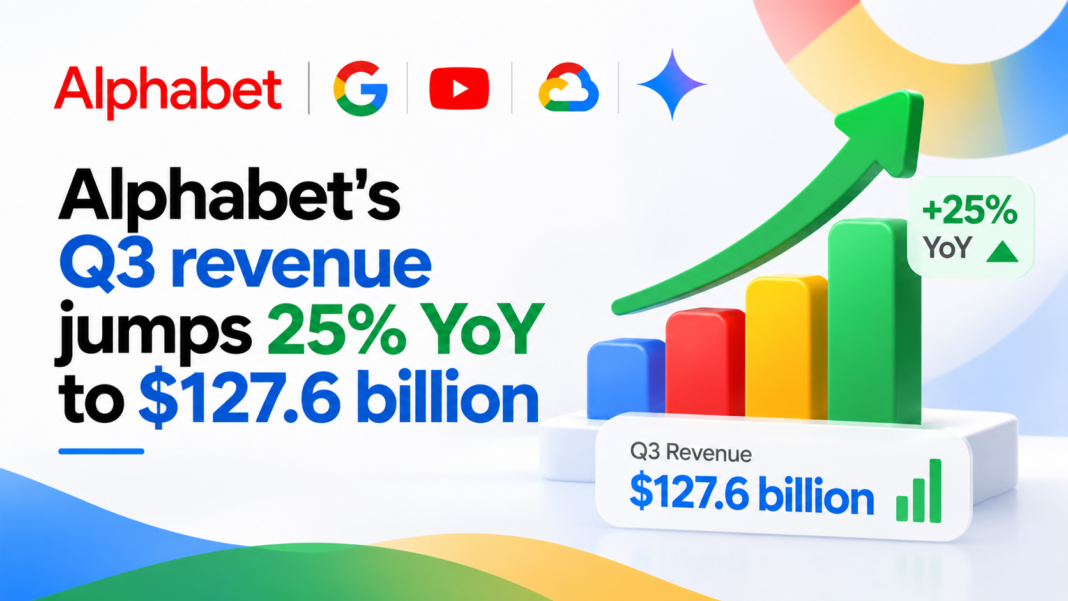
Alphabet Q3 results show a company growing at a pace few firms of its size manage, and the engine behind that growth has shifted. Revenue rose 25% year on year to $127.6 billion for the quarter ended September 30, 2026, against $102.3 billion a year earlier. Google Cloud, not Search, did most of the work.
Cloud revenue more than doubled to $30.7 billion, and the way that single segment dominates the quarter’s growth is the central story. Below we set out the numbers, then add our own analysis of what they say about Alphabet’s direction.
Alphabet Q3 Results: 8 Key Facts
- Revenue: $127.6 billion, up 25% from $102.3 billion.
- Operating income: $40.6 billion, up 30%, with a 31.8% operating margin.
- Google Cloud revenue: $30.7 billion, up 103% from $15.2 billion.
- Google Cloud operating income: $11.1 billion, more than triple the $3.6 billion a year earlier.
- Google Services revenue: $96.3 billion, up 11%.
- Search and other: $63.4 billion, up 12%, with query growth at its highest in five years.
- Gemini app: One billion users, according to CEO Sundar Pichai.
- Run rate: Pichai said Alphabet is now at a half-trillion-dollar annual revenue run rate.
Alphabet Q3 Results by Segment
| Segment | Q3 2026 | Year Earlier | Growth |
|---|---|---|---|
| Total revenue | $127.6 billion | $102.3 billion | +25% |
| Google Services | $96.3 billion | $87.1 billion | +11% |
| Google Search and other | $63.4 billion | $56.6 billion | +12% |
| YouTube advertising | $11.2 billion | $10.3 billion | +9% (our calculation) |
| Google Network | $7.5 billion | $7.4 billion | +1% (our calculation) |
| Total advertising | $82 billion | $74.2 billion | +11% (our calculation) |
| Subscriptions, platforms and devices | $14.3 billion | $12.9 billion | +11% (our calculation) |
| Google Cloud | $30.7 billion | $15.2 billion | +103% |
Operating income rose 30% to $40.6 billion. Google Cloud’s operating income climbed to $11.1 billion from $3.6 billion.
Cloud: The Fastest-Growing Business
Alphabet said Cloud growth came from demand for enterprise AI infrastructure and solutions on Google Cloud Platform, alongside core cloud services, with sales of its tensor processing unit (TPU) systems also contributing. Pichai said demand is strong across a broad range of customers.
AI Numbers From the Quarter
- Model API traffic: Alphabet’s first-party model APIs processed nearly 32 billion tokens per minute, more than four times a year earlier.
- Gemini app: Reached one billion users, which Pichai called the fastest-growing product in Google’s history.
- Search: Pichai said AI investments are driving query growth, including commercial queries, and that the year-on-year growth rate in queries is the highest in five years.
- YouTube: YouTube Music and Premium passed 150 million subscribers globally, including trial users.
Our Analysis: What the Alphabet Q3 Results Really Say
This section is our own analysis and opinion. The calculations are simple arithmetic on reported figures and are not published by Alphabet. It is not investment advice.
1. Cloud delivered about 61% of the revenue growth
Alphabet added roughly $25.3 billion of revenue year on year. Cloud added about $15.5 billion of that ($30.7 billion minus $15.2 billion), which is about 61% of all growth (our calculation). Google Services, which is three times bigger than Cloud, contributed about $9.2 billion, or 36%. This is the sharpest way to see the shift: the company’s smaller segment now supplies most of its growth.
2. Cloud also did most of the profit growth
Cloud operating income rose by $7.5 billion ($11.1 billion minus $3.6 billion). Total operating income rose from roughly $31.2 billion to $40.6 billion, a gain of about $9.4 billion (our calculation, backed out from the reported 30% growth). That would put Cloud at about 80% of the increase in operating profit. Cloud now produces about 27% of Alphabet’s operating income, up from roughly 12% a year earlier (our calculations).
3. Cloud’s margin jumped, which is unusual during rapid expansion
Cloud’s operating margin works out to about 36%, up from about 24% a year earlier (our calculation). Fast-growing infrastructure businesses often see margins fall as they spend on capacity. Here, margin and growth rose together. The announcement gives no explanation, but it fits a story of strong pricing, high demand and sales of TPU systems. We’d want to know how much of the profit comes from the TPU sales, since the source doesn’t break it out.
4. Everything outside Cloud still grew about 11%
Take Cloud out and the rest of Alphabet generated about $96.9 billion against $87.1 billion, up about 11% (our calculation). That is a healthy rate for a business of that scale. In other words, the core did not stall while Cloud surged.
5. Search accelerated into a tougher comparison
In July, Alphabet’s CFO warned analysts that Q3 would be harder because the company would begin lapping an acceleration in Search that started in the third quarter of last year, according to reporting at the time. Despite that, Search grew 12% and query growth was the highest in five years. We read that as a sign that AI features are adding to, not cannibalising, Search activity, though revenue per query and the mix of AI results aren’t disclosed in the figures we have.
6. Advertising is the slow lane inside the fast company
Total advertising grew about 11%, YouTube ads about 9% and the Network business about 1% (our calculations). Ads remain the largest earnings pool, and the Network line is nearly flat. The company’s growth story is increasingly a story of Cloud and AI, with advertising supplying steady, not spectacular, expansion.
7. Tokens and users show the scale of AI usage
A year earlier, Alphabet said its first-party model APIs processed about 7 billion tokens per minute, and the Gemini app had about 650 million monthly active users, according to reports on the Q3 2025 call. Against that, 32 billion tokens per minute is about 4.6 times the earlier level (our calculation), and one billion users is about 54% more. Caution on the user comparison: last year’s number was explicitly monthly active users, and the current announcement just says “users,” so the two may not be measured the same way. At 32 billion tokens per minute, the daily total is on the order of 46 trillion tokens (our calculation).
8. The question marks are capacity and spending
We don’t have Q3 2026 capital spending in the figures we reviewed. For context, at the Q2 call in July, Alphabet reported $44.9 billion of quarterly capex, raised its 2026 capex guidance to $195 to $205 billion and said it was supply-constrained, planning to use third-party capacity as a bridge. It also reported a Google Cloud backlog of $514 billion. Those numbers matter here: the Q2 quarterly capex alone was larger than this quarter’s entire operating income of $40.6 billion (different quarters, so only a scale comparison). The backlog is also roughly 17 times Q3 Cloud revenue, though the Q3 backlog hasn’t been shown in what we reviewed. If capacity is the bottleneck, Cloud’s growth rate is as much a function of how fast Alphabet can build as of demand.
9. What we would watch
The most useful numbers to track are Q3 capex and the new Cloud backlog, whether Cloud margin holds as capacity expands, and whether Search revenue growth stays at or above 12% once AI features mature. A final point: Cloud doubling is a figure that is hard to repeat from a larger base, so the growth rate will almost certainly slow. What matters is the pace and the profit.
What We Still Don’t Know
- Net income and earnings per share for the quarter
- Q3 capital expenditure and updated full-year guidance
- Cloud backlog at September 30, 2026
- How much of Cloud revenue comes from TPU sales
- Other Bets and corporate costs
- Headcount and cost trends
- Market reaction to the results
What to Watch Next
- The earnings call detail on capex, backlog and capacity
- Cloud growth and margin in Q4
- Search and AI Mode monetisation
- YouTube ad growth and subscription momentum
- New Gemini model releases and API usage
- Rivals’ results from Microsoft and Amazon cloud units
Frequently Asked Questions About the Alphabet Q3 Results
What was Alphabet’s revenue in Q3 2026?
$127.6 billion, up 25% from $102.3 billion a year earlier.
How much did Google Cloud grow?
Cloud revenue rose 103% to $30.7 billion, and its operating income rose to $11.1 billion from $3.6 billion.
What was Alphabet’s operating margin?
31.8%, with operating income of $40.6 billion, up 30%.
How did Google Search perform?
Search and other revenue rose 12% to $63.4 billion. Alphabet said query growth was the highest in five years.
How big is Google’s advertising business?
Total advertising revenue was $82 billion, up from $74.2 billion.
How many people use the Gemini app?
Sundar Pichai said it reached one billion users.
How many YouTube Music and Premium subscribers are there?
More than 150 million, including trial users.
Disclaimer
This article is based on Alphabet’s reported Q3 2026 results as published by trade media, and on published reports of earlier quarters for context. We did not review the full filing or earnings call. Derived numbers (growth shares, margins, ratios and token estimates) are our own approximate calculations, not company data. The “Our analysis” section is opinion and does not constitute investment, financial or legal advice. Readers should check Alphabet’s official filings before making decisions. This site is not affiliated with Alphabet or Google.
To read more tech and business coverage, see our posts on Google Cloud and AI news and how to read quarterly results. You can also visit Alphabet’s investor relations page and read the original coverage on Yahoo Finance.