


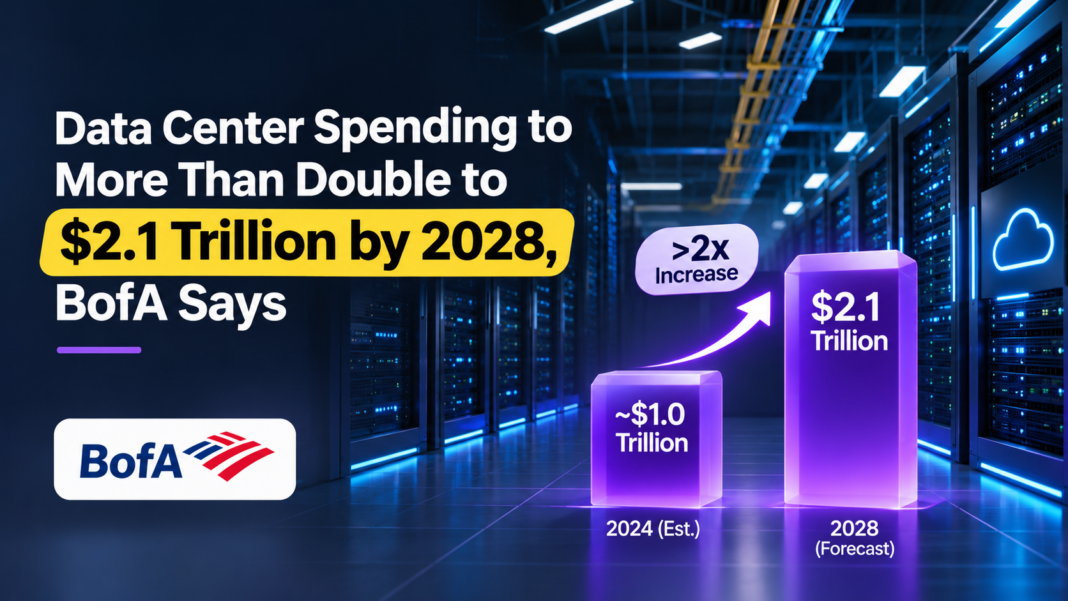
Data center spending is on track to reach $1 trillion in 2026 and more than double to $2.1 trillion by 2028, according to Bank of America Global Research estimates reported by Reuters on October 23, 2026. The driver is artificial intelligence, which needs enormous amounts of computing capacity, advanced servers, fast networking and reliable power.
The forecast is big enough to move industries well beyond chipmaking. This article sets out what BofA expects, where the money goes and which risks could slow things down, then adds our own analysis of what the numbers imply.
Data Center Spending: 7 Key Facts
- 2026: About $1 trillion in expected global spending.
- 2028: More than $2.1 trillion, over double the 2026 level.
- 2030: The market could reach $2.93 trillion, according to BofA.
- IT share: IT-related expenses make up 78% of total spending.
- Biggest cost: Servers, at an estimated $31.4 million per megawatt.
- Neocloud premium: AI-focused facilities cost about $57 million per megawatt, against $49 million overall.
- Risks: Electricity, equipment supply, construction capacity, financing and local opposition.
Why Data Center Spending Is Expected to Surge
Generative AI and other computing-heavy services are changing the economics of digital infrastructure. AI models need powerful processors, large memory and storage, fast links between servers and a lot of electricity. As businesses build AI into search, software development, customer service and enterprise workflows, cloud companies and specialised AI infrastructure providers need more data centers to host the servers behind those services.
BofA says the global data center market was worth about $275 billion in 2022 and could grow at a compound annual rate of 37% from 2025 to 2030. That is a forecast, not a guarantee, and the actual path depends on AI adoption, how fully the new capacity gets used and the economics of building it.
BofA’s Data Center Spending Forecast at a Glance
| Metric | BofA Estimate |
|---|---|
| Global data center market, 2022 | $275 billion |
| Expected spending, 2026 | $1 trillion |
| Expected spending, 2028 | $2.1 trillion |
| Potential market size, 2030 | $2.93 trillion |
| Estimated market CAGR, 2025 to 2030 | 37% |
Source: BofA Global Research, as reported by Reuters on October 23, 2026. These are projections, not guaranteed spending or the revenue of any one company.
Where the Money Goes: Servers Take the Biggest Slice
A data center is far more than a building. Operators must buy computing hardware, connect servers with high-speed networks, deliver electricity and keep temperatures under control. BofA estimates that IT-related expenses account for 78% of total spending.
| Component | Estimated Cost per Megawatt |
|---|---|
| Total data center construction and equipment | $49 million |
| Servers | $31.4 million |
| Networking | $4.8 million |
| Other individual infrastructure functions | About $0.1 million to $1.1 million each |
These figures are estimates, not a full itemised bill for every project. Real costs vary with the type of facility, the computing equipment, power density, cooling needs and location.
Why AI-Focused “Neocloud” Data Centers Cost More
AI-focused data centers, often called neoclouds, are built for intensive computing. They tend to use dense accelerator systems that draw a lot of power and need specialised cooling. BofA estimates they cost about $57 million per megawatt, compared with $49 million for data centers overall.
AI facilities may need less floor space for a given amount of computing, but the hardware and power demands push the cost per megawatt higher. Two sites with the same electrical capacity can cost very different amounts depending on the processors, cooling and networking they use.
Which Industries Benefit From the Data Center Spending Boom?
| Industry | Why It Gains |
|---|---|
| Semiconductors and servers | Processors, memory, storage and complete server systems are the largest part of the bill |
| Networking equipment | Larger server clusters need more switches, interfaces and high-speed links |
| Power infrastructure | Switchgear, electrical distribution, generators and backup power are essential |
| Cooling systems | High-performance chips generate heat that must be removed reliably |
| Construction and engineering | New sites need land, buildings, grid connections and specialised building services |
That spread means the AI boom reaches into traditional industrial markets. Firms that once served factories, commercial buildings or power projects may find new demand from technology developers.
Our Analysis: What the Data Center Spending Numbers Really Say
This section is our own analysis and opinion. The calculations below are simple arithmetic based on BofA’s reported figures. They are not published by BofA or Reuters. It is not investment advice.
1. The forecast assumes growth slows sharply after 2028
Going from $1 trillion in 2026 to $2.1 trillion in 2028 means spending grows about 45% a year for two years. But going from $2.1 trillion in 2028 to $2.93 trillion in 2030 is only about 18% a year. In other words, the forecast bakes in a very fast sprint followed by a much slower pace. That shape is worth noticing. It suggests even the optimists expect the build-out to hit limits, whether power, money or demand, before the end of the decade.
2. The 2025 starting point looks surprisingly small
A 37% compound annual growth rate ending at $2.93 trillion in 2030 implies 2025 spending of roughly $0.6 trillion, a number we derived and BofA did not state. If correct, spending would jump about 65% between 2025 and 2026 alone. It shows how recent and how abrupt this surge is. In 2022, the market was about $275 billion, so the 2026 figure of $1 trillion would be roughly 3.6 times larger in four years.
3. What $2.1 trillion could mean in physical capacity
This is a rough back-of-the-envelope estimate, not a forecast. At the $49 million per megawatt overall cost, $1 trillion would equal about 20 gigawatts of capacity, and $2.1 trillion about 43 gigawatts. The real figure will differ, because spending includes upgrades, replacements and non-construction items, and costs per megawatt change. But the exercise makes the point: the plan implies adding tens of gigawatts of electricity demand in just a few years. That is why power, not chips, may become the deciding constraint.
4. Servers are almost two-thirds of the cost
Servers at $31.4 million per megawatt are about 64% of the $49 million total, and servers plus networking are about 74%. The building and the power and cooling plant are the smaller part. This matters for the risks: if AI hardware improves quickly and older servers lose value, the largest cost on the balance sheet is also the one that ages fastest. That is a risk to returns that headline spending numbers do not show.
5. The neocloud premium is about 16%
At $57 million versus $49 million, AI-focused facilities cost roughly 16% more per megawatt. A premium of that size is not huge, but it compounds across thousands of megawatts, and it shows why operators chasing AI customers need strong contracts to justify the extra cost.
6. The India angle, as our reading
Your source and BofA do not discuss India, so this is our own view. India has growing cloud and AI demand, a large pool of engineers and rising data center construction. A global build-out of this size will compete for the same servers, cooling gear and electrical equipment. Indian operators may face longer waits and higher prices for equipment, while local manufacturers of power and cooling products could find export or domestic opportunities. Electricity supply and land will matter as much here as anywhere.
7. What we would watch
We would track the share of new capacity covered by signed customer contracts. Spending forecasts only turn into profit if customers pay for the space. If operators build ahead of demand, today’s boom could become tomorrow’s glut.
Power Constraints and Other Risks Could Slow Data Center Spending
A forecast does not mean every planned data center will be built on time. The main constraints are:
- Electricity: Large sites need reliable power connections, and new generation and transmission can take years to build. Delays in grid links, permits or equipment can push back timelines and raise costs.
- Financing: The upfront cost is huge, and developers need enough expected demand and customer commitments to justify it. If AI demand grows more slowly than expected or capacity sits idle, returns could disappoint.
- Equipment supply: Servers, electrical gear and cooling systems can be in short supply.
- Local opposition: Residents and policymakers have raised concerns about electricity bills, water use, land and environmental effects, which can slow planning and permits.
What We Still Don’t Know
- Who is spending: The split between big cloud companies, neoclouds and other buyers.
- Regional breakdown: How much of the spending lands in the US, Europe, Asia or India.
- Utilisation: How fully the new capacity will be used.
- Hardware lifespan: How long servers will stay useful before replacement.
- What the spending covers: Whether figures include land, power plants or only facilities and equipment.
What to Watch Next
- Quarterly capital spending from major cloud and AI companies
- Power and grid announcements tied to new data center sites
- Equipment lead times for servers, switchgear and cooling systems
- Customer contracts signed by neocloud providers
- Local permit fights and regulation on energy and water use
Frequently Asked Questions About Data Center Spending
How much will global data center spending reach by 2028?
BofA Global Research expects it to exceed $2.1 trillion by 2028, compared with about $1 trillion in 2026.
What is driving the increase?
Demand for AI services is the main driver. AI models need powerful servers, networking, storage, electricity and cooling, so cloud providers and specialised operators are expanding capacity.
Which part of a data center costs the most?
Servers. BofA estimates them at about $31.4 million per megawatt, followed by networking at $4.8 million.
What are neocloud data centers?
They are AI-focused data center providers and facilities built around high-performance computing. BofA estimates they cost about $57 million per megawatt, against $49 million for data centers overall.
How big could the data center market be by 2030?
BofA says it could reach $2.93 trillion.
Could the spending slow down?
Yes. Power shortages, grid delays, equipment constraints, financing costs, regulation and slower AI adoption could all affect schedules and returns.
Is this forecast a guarantee?
No. It is one bank’s projection, and actual spending will depend on demand, power and project economics.
Disclaimer
This article is based on Bank of America Global Research estimates as reported by Reuters on October 23, 2026. All forecasts are projections and not guaranteed outcomes. Derived figures (such as annual growth rates, implied 2025 spending, share-of-cost percentages and gigawatt estimates) are our own approximate calculations from the reported numbers, not data published by BofA. The “Our analysis” section is opinion and does not constitute investment, financial or legal advice. This site is not affiliated with Bank of America.
To read more AI and tech coverage, see our posts on AI infrastructure news and Nvidia and AI chips. You can also read the original Reuters report and BofA’s research page on Bank of America Global Research.