


ZapiFlow Plans Arattai Business Expansion Beyond WhatsApp API
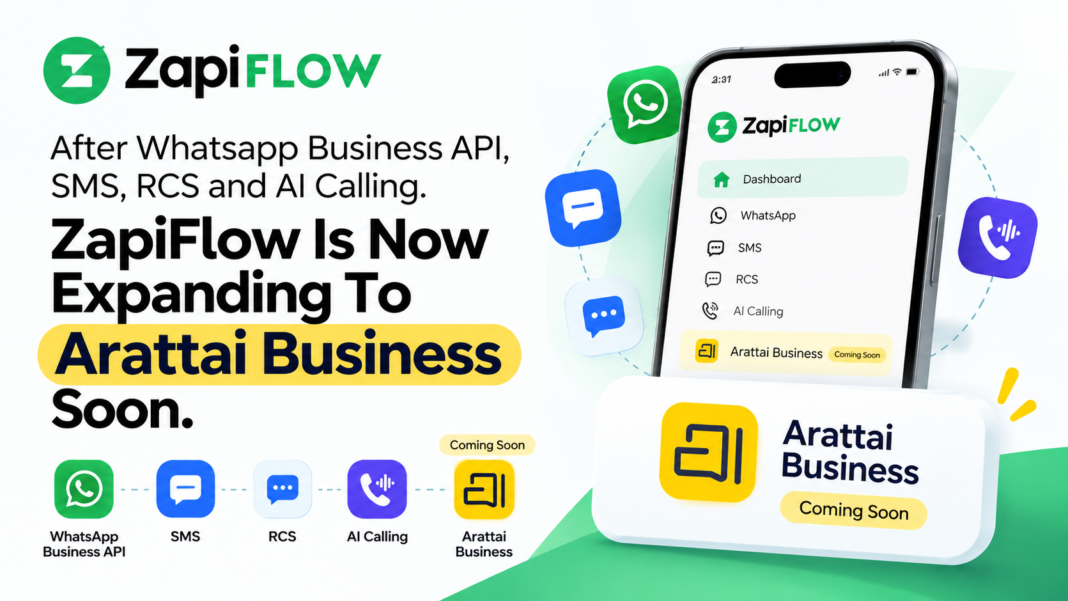
ZapiFlow Arattai expansion plans could add another messaging channel to the Indian business communication platform’s portfolio, which already spans WhatsApp Business API, SMS, Rich Communication Services (RCS) and AI calling. As of October 29, 2026, the proposed integration remains unconfirmed in terms of its launch date, features and availability.
The potential move raises a practical question for businesses: could ZapiFlow eventually help organizations reach customers through Arattai alongside their existing communication channels?
For now, the available information points to a planned expansion rather than a live integration. That distinction matters for companies evaluating messaging platforms, because an announced direction is not the same as a working product.
5 Key Facts About ZapiFlow Arattai
- ZapiFlow is preparing to expand its business communication ecosystem toward Arattai Business.
- Its existing communication focus includes WhatsApp Business API, SMS, RCS and AI-powered calling.
- Arattai is a messaging application developed by Zoho.
- The proposed integration could add another channel to ZapiFlow’s customer engagement offering.
- No confirmed launch date, feature list or technical integration details are provided in the source.
- Businesses should wait for confirmed availability before making implementation decisions.
- ZapiFlow’s website is zapiflow.in.
ZapiFlow Arattai: What the Planned Expansion Means
The proposed ZapiFlow Arattai move signals an interest in expanding beyond a single messaging channel. Businesses communicate with customers for different reasons: sending updates, answering enquiries, supporting purchases and maintaining ongoing relationships.
A platform that brings multiple communication methods together can potentially reduce the need to manage each channel through a separate system. However, the actual benefit depends on how well those channels are integrated and what businesses can do with them.
ZapiFlow’s existing portfolio covers several communication methods. WhatsApp Business API supports business messaging, SMS provides a familiar text-based channel, RCS offers a richer messaging format, and AI calling introduces voice-based interactions.
Arattai could become an additional option if the proposed integration is delivered. At present, we cannot establish whether it will support automated notifications, customer service conversations, campaign management or other specific business workflows.
That is the key distinction between the strategic direction and the product details. The direction is clear enough to discuss; the implementation remains unknown.
Why ZapiFlow Is Looking Beyond WhatsApp Business API
WhatsApp Business API is one part of ZapiFlow’s stated communication portfolio, but businesses do not all communicate with customers in the same way.
A retailer may need order updates. An education provider may need administrative notifications. A service business may rely on voice calls for enquiries, while another organization may prefer text-based reminders.
Having multiple channels available can give businesses more options when choosing how to reach their audiences. It may also help them avoid relying entirely on a single communication method.
The ZapiFlow Arattai proposal fits this broader multi-channel approach. Still, adding another channel only creates value if customers can actually be reached through it and businesses can manage the resulting interactions reliably.
For organizations considering such a platform, the important questions go beyond the number of supported channels. They include delivery reliability, integration quality, reporting, automation, access controls and the effort required to manage conversations.
The source does not confirm how ZapiFlow intends to address these areas for Arattai.
What Is Arattai, and Why Could It Matter to ZapiFlow?
Arattai is a messaging application developed by Zoho. Its possible inclusion in ZapiFlow’s ecosystem would introduce another messaging environment for the platform to explore.
For businesses, the value of a messaging integration depends on whether it enables useful, permitted workflows. These might include handling customer conversations or coordinating communications, but such capabilities should not be assumed to exist in this proposed integration.
The phrase Arattai Business also needs careful interpretation. It appears in the supplied announcement as the name of the planned expansion, but the source does not establish whether it refers to a separately launched business product, a formal integration offering or a proposed business messaging capability.
That uncertainty matters. Businesses should not confuse a platform’s intention to support a messaging service with official access to business APIs or an approved method of automation.
Until the integration is documented, its intended users, technical requirements and supported functions remain open questions.
How ZapiFlow’s Communication Portfolio Could Evolve
ZapiFlow’s stated portfolio includes four communication categories before the proposed Arattai expansion. Each serves a different role in a broader customer communication strategy.
| Channel | General business use | Status in the supplied information |
|---|---|---|
| WhatsApp Business API | Business messaging and customer engagement | Part of ZapiFlow’s existing portfolio |
| SMS | Text-based notifications and communication | Part of the stated portfolio |
| RCS | Richer messaging experiences | Part of the stated portfolio |
| AI calling | Voice-based customer interactions | Part of the stated portfolio |
| Arattai Business | Potential additional messaging channel | Planned; implementation details unconfirmed |
This comparison describes the broad role of each channel, not a verified list of ZapiFlow features. The source does not provide technical specifications, pricing or feature-level documentation.
The proposed ZapiFlow Arattai expansion could make the portfolio broader, but breadth alone is not proof of product quality. A useful multi-channel platform needs to make its channels work together in a way that is manageable for customers.
For example, businesses would need clear answers about whether they can manage interactions from one dashboard, use shared automation rules, measure performance across channels and control who can access customer information. None of these capabilities has been confirmed for Arattai.
What Businesses Should Consider Before Adopting a New Messaging Channel
Businesses evaluating ZapiFlow or any multi-channel communication provider should separate current capabilities from planned additions.
First, confirm whether the channel is officially available. A planned integration should not be treated as ready for deployment.
Second, ask which functions are supported. Sending a notification, initiating a conversation and managing two-way customer support are different capabilities. The platform’s documentation should specify which are available.
Third, review the technical and commercial requirements. Businesses may need information about account eligibility, authentication, API access, usage limits, pricing and applicable messaging policies.
Finally, assess whether the channel solves a real problem. Adding another messaging service may be useful if customers actively use it and the integration reduces operational work. If not, it could create another system to monitor without delivering meaningful benefits.
These are evaluation criteria rather than claims about ZapiFlow’s planned implementation.
Our Analysis: The Real Test Is Integration, Not the Number of Channels
This section is our editorial analysis based on the information supplied, not a statement of ZapiFlow’s confirmed plans beyond the proposed expansion.
The ZapiFlow Arattai proposal points toward a familiar challenge in business software: adding communication options is relatively easy to describe, but making them useful together is the harder part.
1. Who could benefit?
Businesses already managing several communication channels could benefit if an Arattai integration reduces the work involved in switching between systems. Smaller businesses may particularly value a straightforward setup that does not require separate processes for every channel.
However, these benefits depend on actual functionality. We do not yet know whether the planned integration will provide centralized inbox management, automation or reporting.
2. Who could be left out?
Organizations that adopt a new channel before confirming its availability or customer relevance could spend time preparing workflows that cannot yet be deployed. Teams may also face extra work if the integration requires separate management or does not support their existing processes.
For that reason, the prudent approach is to evaluate the proposed channel without treating it as a replacement for currently available communication tools.
3. The hidden signal: businesses want communication choices
ZapiFlow’s stated combination of messaging, RCS and AI calling suggests a broad approach to customer engagement. The proposed Arattai addition would extend that direction if it moves into a working integration.
Our reading is that the competitive question is not simply how many channels a provider lists. It is whether a business can choose the right channel for a particular customer interaction without adding unnecessary complexity.
A larger channel list is only useful when supported by reliable delivery, clear policies and manageable workflows.
4. The India angle
For Indian businesses, communication systems can support customer enquiries, order updates, service reminders and other routine interactions. A wider choice of channels could be useful where different customer groups prefer different ways to communicate.
But the source provides no adoption figures, user data or customer research demonstrating demand for an Arattai integration specifically. We should not assume that businesses will adopt it simply because the option becomes available.
Its value in India will depend on customer usage, business eligibility, technical access and the quality of the final integration.
5. The risk most coverage could miss
The biggest uncertainty is not the announcement’s ambition; it is the gap between a proposed integration and a usable service.
Official access, supported workflows, compliance requirements and maintenance arrangements all affect whether a business messaging integration can be relied on. These details should be clarified before businesses build important customer processes around the channel.
6. What we would watch next
We would look for a formal launch announcement, documentation describing the integration, a confirmed availability date and a clear list of supported features.
Those details would allow businesses to assess the offering on its actual capabilities rather than its intended direction.
What We Still Don’t Know About ZapiFlow Arattai
The supplied information leaves several important questions unanswered. Until ZapiFlow provides more detail, the following points should remain open rather than being presented as confirmed features.
- Launch date: No date has been provided for the proposed integration.
- Official confirmation: The source does not include an official announcement from Zoho confirming a ZapiFlow integration.
- Feature availability: It is unclear whether the planned offering will support notifications, two-way messaging, automation, customer support or campaign management.
- Technical access: There is no confirmed information about API access, authentication, integration requirements or account eligibility.
- Pricing: The source does not state whether the integration will be included in existing plans or offered separately.
- Geographic availability: No rollout markets or regional restrictions have been specified.
- Business eligibility: It is not clear which types of businesses will be able to use the proposed integration.
These are not minor details. They determine whether a planned messaging channel can become a practical business tool.
What to Watch Next
The next meaningful development would be confirmation from ZapiFlow that the integration is available or has entered a defined launch phase.
We would watch for four developments:
- An official announcement: Confirmation of the initiative and a clearer description of what ZapiFlow intends to offer.
- Product documentation: Technical details explaining how businesses would access and use the integration.
- A feature and pricing list: Clear information about supported workflows, account requirements and any additional charges.
- Availability for customers: Confirmation that eligible businesses can actually activate and use the service.
For now, businesses interested in the ZapiFlow Arattai proposal can follow updates through ZapiFlow’s official website. Until further information is available, existing communication channels should remain the basis for operational planning.
Frequently Asked Questions
1. What is the ZapiFlow Arattai expansion?
It is a proposed expansion of ZapiFlow’s business communication ecosystem toward Arattai Business. The supplied information does not confirm a completed integration or launch date.
2. What is Arattai?
Arattai is a messaging application developed by Zoho. The source does not establish the technical or commercial details of the proposed ZapiFlow integration.
3. Has ZapiFlow launched Arattai Business?
The supplied information describes the expansion as planned. It does not confirm that the integration is live or available to customers.
4. Which communication channels does ZapiFlow currently list?
The source identifies WhatsApp Business API, SMS, RCS and AI calling as part of ZapiFlow’s communication portfolio.
5. Will businesses be able to automate Arattai messages through ZapiFlow?
That has not been confirmed. Automation, message types and other supported functions would need to be specified in official product documentation.
6. Will Arattai Business cost extra?
No pricing information is provided in the source. Businesses will need to check ZapiFlow’s published plans and terms if the integration becomes available.
7. Where can readers find ZapiFlow updates?
Readers can visit zapiflow.in for information from ZapiFlow. The launch status and integration details should be confirmed through official announcements.
Disclaimer: This article is based solely on the supplied source material. The proposed Arattai Business integration, its availability, features and launch timeline have not been independently verified. The analysis and potential use cases are editorial interpretations, not confirmed product commitments.
Related reading: Marketing · Business
External link: ZapiFlow official website