


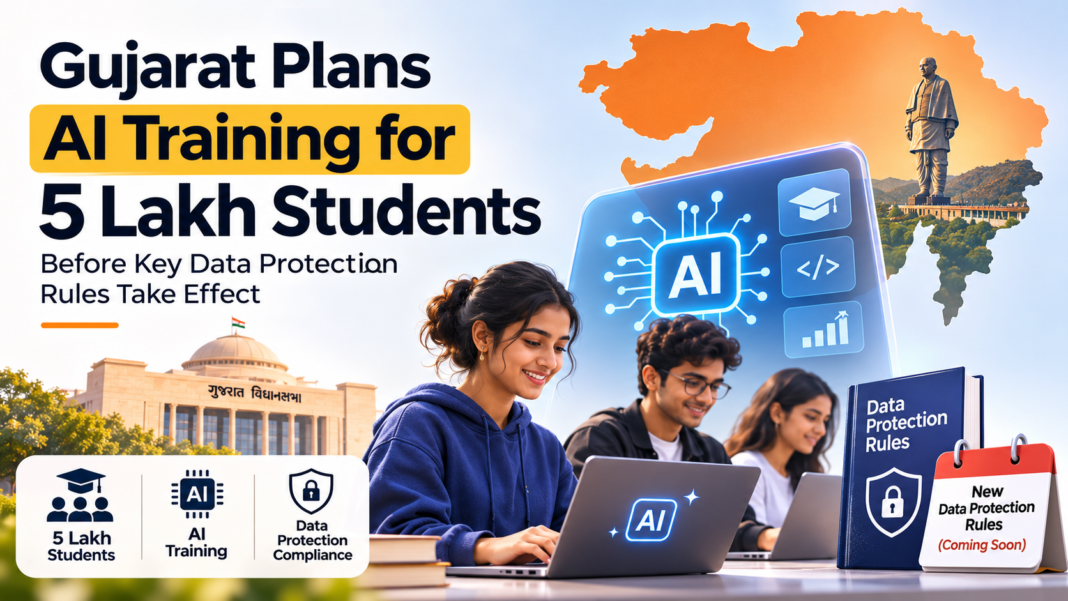
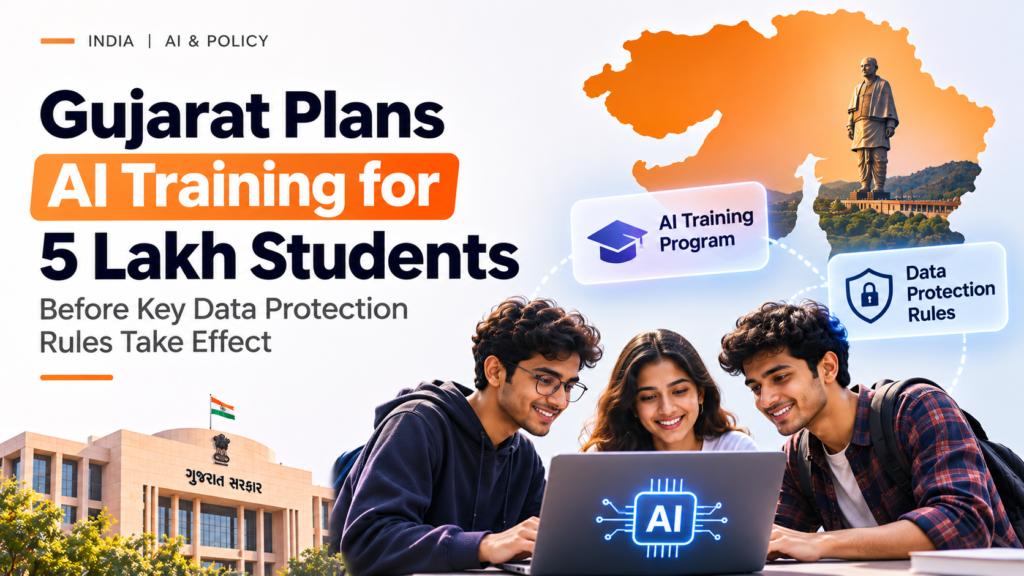
The Gujarat AI for Every Student Mission is a draft plan to train five lakh students across the state’s higher education institutions in artificial intelligence during 2026–27. Gujarat’s Higher Education Department has prepared the draft policy, according to reporting by The Times of India. It reportedly carries ₹20 crore in state funding and a target of training 5,000 faculty members as AI Master Trainers within 12 months.
The plan is a proposal. It still needs administrative and financial clearances, and final implementation details are not confirmed. The timing is notable because key provisions of India’s Digital Personal Data Protection (DPDP) framework are scheduled to take effect in May 2027, which raises a practical question: how do you teach millions of hours of AI use while protecting students’ personal data?
How we reported this: This article is based on reporting by The Times of India on the draft policy, and on the Press Information Bureau and a law-firm DPDP timeline for the data protection dates. We have not seen the full draft document. Figures about the mission are as reported and may change. Our own interpretation appears in the section marked “Our analysis.”
Gujarat AI for Every Student Mission: 7 Key Facts
- Target: Five lakh students across higher education institutions.
- Three levels: An 8-hour foundation course, a 25-hour applied course and a 50-hour advanced programme.
- Funding: A reported ₹20 crore from the state, subject to approvals.
- Faculty: 5,000 AI Master Trainers within 12 months.
- Languages: Modules in English and Gujarati.
- Delivery: The introductory course is expected to run online, mainly using freely available resources.
- Status: A draft awaiting clearances, not a final policy.
What Is the Gujarat AI for Every Student Mission?
The mission aims to give a large number of college students basic AI knowledge while letting some learners go much deeper. The introductory course would cover artificial intelligence, generative AI tools and prompting fundamentals. Later stages would focus on using AI within specific academic disciplines and on practical, project-based work.
The final schedule, the list of participating institutions and operating arrangements will depend on government clearances.
How the Three-Tier Training Would Work
| Training Level | Duration | Target Students | Main Focus |
|---|---|---|---|
| AI Foundation for Every Student | 8 hours | 5 lakh | AI basics, generative AI, prompting and productivity |
| AI for Domain Applications | 25 hours | 1 lakh | Applying AI to specific academic and professional fields |
| Advanced AI Skills and Employability | 50 hours | 20,000 | Projects, specialised workflows, industry cases and assessments |
Students would generally move to the second and third levels after completing the previous one or showing equivalent skill.
The applied programme would cover eight broad subject areas: commerce and finance, engineering and technology, arts and humanities, science and mathematics, education, agriculture, healthcare, and law and public administration.
The advanced course would include practical labs, specialised AI workflows, data administration, capstone projects and final assessments, with the stated goal of building skills students can demonstrate in academic or professional settings.
Why 5,000 Faculty Master Trainers Matter
A statewide AI programme needs people who can explain the technology, help students check AI outputs and connect the tools to their own subjects. The draft proposes training 5,000 faculty members as AI Master Trainers within 12 months.
The reported delivery structure includes:
- A State Mission Unit to coordinate the programme
- Nodal officers nominated by universities
- Coordinators appointed by colleges
- A statewide dashboard tracking enrolment, certification and progression through unique learner IDs
- Institutional reviews and independent checks of selected outcomes
How well these arrangements work will depend on the final assessment criteria, the quality of training and how consistently colleges apply it.
Why the DPDP Act Matters for AI Education
India’s Digital Personal Data Protection Act, 2023, sets out a framework for processing digital personal data. According to the sources cited in the original report, the rules were notified in November 2025 and are being implemented in phases:
| Milestone | Timing |
|---|---|
| Rules notified | November 2025 |
| Certain institutional provisions | Took effect earlier |
| Consent manager registration provisions | November 2026 |
| Key substantive obligations (notice and consent, security safeguards, individual data rights) | May 2027 |
The government has also explained that existing information technology privacy and security requirements continue to apply during the transition. So May 2027 should not be read as the date privacy responsibilities begin.
Sources: Press Information Bureau and Shardul Amarchand Mangaldas & Co’s DPDP implementation timeline.
What Data Risks Come With Students Using AI Tools?
AI learning involves sharing information with outside platforms. Depending on the tool and its settings, data may be stored, processed or used under the provider’s terms. Potential concerns include:
- Personal information in prompts, such as names or contact details
- Sensitive assignments, which may include personal or institutional information
- Account and activity records kept by learning platforms
- Unclear retention, where students don’t know how long data is kept or what else it is used for
- Third-party providers, where institutions have limited visibility into how data is handled
The draft reportedly emphasises responsible AI use, protecting student and institutional data and verifying AI outputs. The approved tools and data-handling procedures will be important to examine once the policy is final.
Our Analysis: What the Gujarat AI Mission Really Signals
This section is our own analysis and opinion, based on the reported figures. The calculations are simple arithmetic and are not published by the Gujarat government. It is not legal or policy advice.
1. The plan is a pyramid, and most students get only a short course
Of five lakh students, the draft sends one lakh (20%) to the applied level and 20,000 (4%) to the advanced level. In other words, 96% of participants would receive only the 8-hour foundation course. That is a meaningful introduction but not a job-ready skill set. The headline “5 lakh students trained” will mostly describe a short course, so readers should look at the 20,000 figure to judge employability impact.
2. The cost works out to about ₹400 per student
Dividing ₹20 crore by five lakh students gives roughly ₹400 per student. Counting total learning time (8 hours for 5 lakh, 25 hours for 1 lakh and 50 hours for 20,000) gives about 75 lakh learner-hours, or roughly ₹27 per learner-hour. That is very low, which is realistic only because the foundation course relies on free online resources. It also suggests the budget is aimed at training the trainers, running the dashboard and paying for the higher levels, not at buying expensive software licences. We don’t know what the ₹20 crore actually covers, so this is a rough guide and not a cost audit.
3. Each master trainer would be linked to about 100 students
Five lakh students divided by 5,000 Master Trainers is 100 students per trainer. That is manageable if the trainers mainly guide and certify, and the content is online. It becomes harder if colleges expect them to run practical labs or evaluate projects for the advanced tier. The quality of the 20,000-student advanced track will probably depend on how well-equipped these trainers are.
4. The privacy question is the real test
A 5-lakh-student programme means a large amount of student data: identities, learning records, certificates and possibly prompts and uploaded work. The state dashboard with unique learner IDs would hold some of it. The questions we would want answered are: which AI tools will students use, where will the data be stored, who is responsible for it and how long will it be kept? The draft reportedly talks about protecting data but we have not seen the detailed rules.
5. Many students are adults, but not all
DPDP treats anyone under 18 as a child and sets extra consent rules. Most higher education students are 18 or older, but first-year students can be 17. Institutions may need a process for those cases. This is our reading and not something the draft discusses, so check it with a legal expert.
6. A short course can build awareness, not skill
An 8-hour introduction can teach a student what generative AI is, how to write a clear prompt and why they should never trust an AI answer without checking. That is valuable. It will not by itself make a graduate stand out to an employer. The mission’s value will depend on whether students use AI in their coursework afterwards and whether the 25-hour and 50-hour courses include real projects.
7. What we would watch
We would track three numbers once the mission starts: completion rates (online courses often lose most learners), how many students reach the advanced tier and how many master trainers are certified by the 12-month mark. Those figures will say far more than the opening target.
What the Mission Could Mean for Students and Employers
For students, the programme could give every discipline a common foundation in AI. Commerce students could explore financial analysis, agriculture students could look at AI-assisted farming workflows and humanities students could use AI for research and organisation. The advanced track could help selected students build projects that show practical skill. Offering modules in English and Gujarati could also help students who are more comfortable in either language.
For employers, graduates who understand how AI fits into everyday work may be easier to onboard. Completing an introductory course does not prove professional ability, though, so the value will depend on whether students can apply what they learn and show it through assessed work.
What We Still Don’t Know
- Final approval: Whether and when the draft gets administrative and financial clearance
- Participating institutions: Which universities and colleges will take part
- Platforms and tools: Which AI tools and learning platforms students will use
- Data safeguards: The privacy, storage and consent arrangements
- Assessment standards: How certification and outcomes will be checked
- Funding details: What the ₹20 crore covers
- Start date: When training will begin
What to Watch Next
- Government approval and the final policy text
- A list of approved AI tools and data-handling rules
- Faculty training launch and how many trainers are certified
- The first enrolment and completion numbers
- How the mission aligns with DPDP rules as they take effect
Frequently Asked Questions About the Gujarat AI for Every Student Mission
What is the Gujarat AI for Every Student Mission?
It is a draft 2026–27 initiative by Gujarat’s Higher Education Department to train five lakh students across higher education institutions in AI through three levels of courses.
How much funding has been proposed?
Reports describe a ₹20 crore state allocation, subject to administrative and financial clearances.
How many students will get advanced training?
The draft targets five lakh students for the foundation course, one lakh for the applied course and 20,000 for the advanced programme.
Who will teach the courses?
The plan proposes training 5,000 faculty members as AI Master Trainers within 12 months.
Has Gujarat officially launched the mission?
Not yet. Reports describe a draft awaiting clearances, and the final launch date and details have not been confirmed.
When do the DPDP rules take effect?
They are being phased in. Key substantive provisions are scheduled for May 2027, while some institutional and consent-manager provisions have earlier dates. Existing privacy and security requirements still apply in the meantime.
What languages will the courses use?
The proposed modules are in English and Gujarati.
Disclaimer
This article is based on media reports of a draft policy that has not been finalised, and on public information about India’s DPDP Act and Rules. Figures, timelines and programme details may change. The “Our analysis” section is opinion, and its calculations are our own approximations. They are not official figures. Nothing here is legal, policy or educational advice. Readers should check the final government notification and the official DPDP text before relying on any detail. This site is not affiliated with the Government of Gujarat.
To read more Martech and AI coverage, see our posts on AI in Indian education and DPDP Act explained. You can also read the official Press Information Bureau release on DPDP and the original report in The Times of India.